
Achievers Institute Header

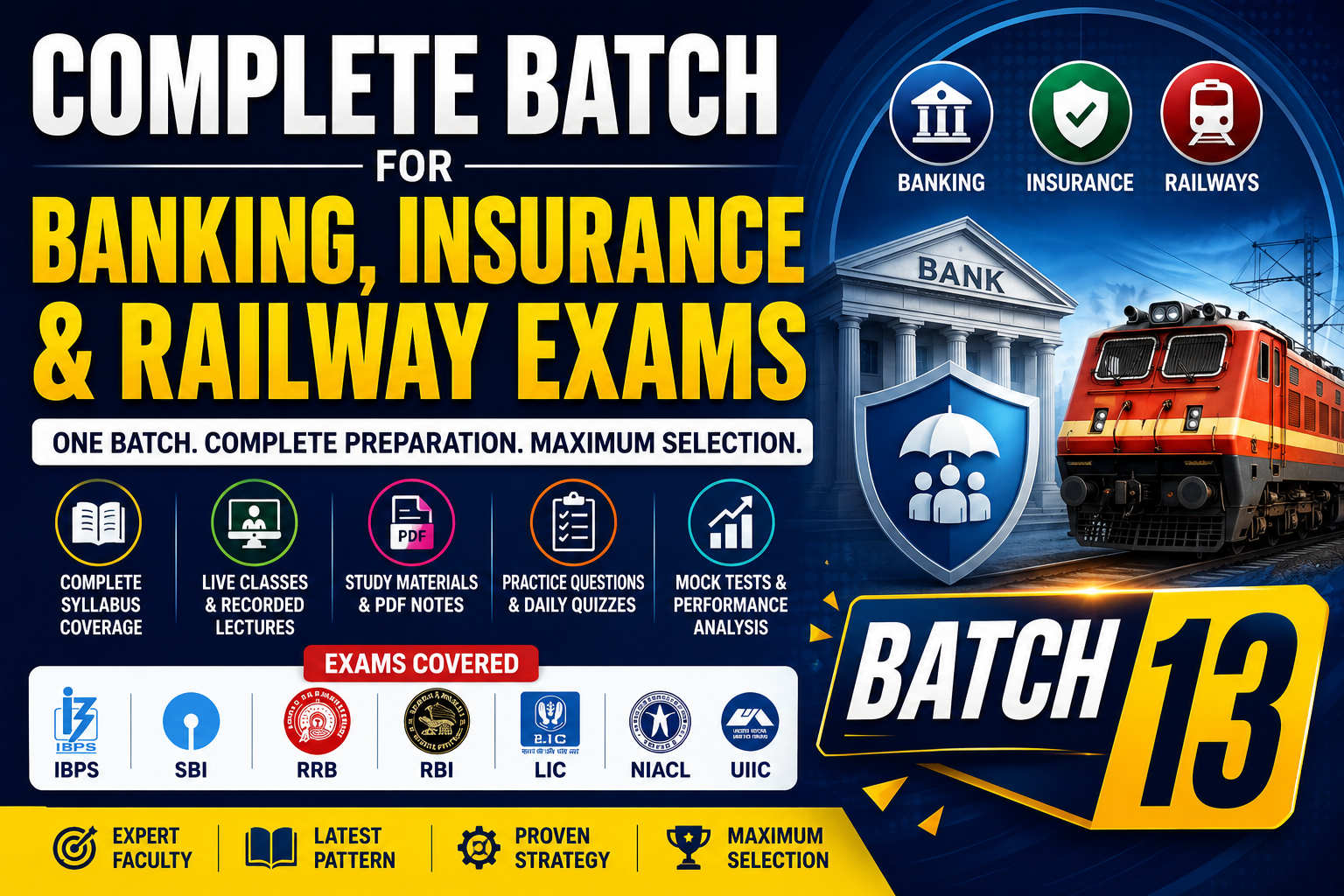
Complete Batch for Banking, Insurance & Railway Exams 2026 | Comprehensive Online Preparation Course for IBPS, SBI, RRB, RBI, LIC & More – Batch 13
Categories: Bank, Government Exams, Live
Wishlist Share

About Course

Prepare for India’s top Banking, Insurance, and Railway competitive exams with Complete Batch 13, a comprehensive online preparation program designed to help aspirants succeed in every stage of the recruitment process. Whether you’re targeting IBPS PO, IBPS Clerk, SBI PO, SBI Clerk, RRB Office Assistant, RRB Officer Scale I, RBI Assistant, LIC AAO, NIACL AO, UIIC AO, Railways (RRB NTPC, Group D, ALP, Technician), or other government recruitment exams, this batch provides everything you need in one place.

Complete Batch 13 follows a structured learning approach that covers the complete syllabus with concept-based teaching, exam-oriented strategies, regular practice sessions, and full-length mock tests. Every topic is explained by experienced faculty to help you build strong fundamentals and improve your speed, accuracy, and confidence.

What You’ll Learn

  • Quantitative Aptitude

  • Reasoning Ability

  • English Language

  • General Awareness & Current Affairs

  • Computer Awareness

  • Data Interpretation

  • Puzzle & Seating Arrangement

  • Arithmetic & Advanced Mathematics

  • Descriptive English (where applicable)

  • Banking & Financial Awareness

  • Railway Exam Special Topics

Course Features

  • Comprehensive coverage of the latest exam syllabus

  • Live interactive classes by experienced educators

  • Recorded lectures for flexible learning

  • Chapter-wise practice questions and PDFs

  • Daily quizzes and assignments

  • Sectional and full-length mock tests

  • Previous Year Questions (PYQs) with detailed solutions

  • Regular doubt-clearing sessions

  • Performance analysis and exam strategies

  • Updated current affairs and banking awareness content

Exams Covered

  • IBPS PO

  • IBPS Clerk

  • IBPS RRB PO

  • IBPS RRB Clerk (Office Assistant)

  • SBI PO

  • SBI Clerk (Junior Associate)

  • RBI Assistant

  • LIC AAO

  • LIC Assistant

  • NIACL AO

  • UIIC AO

  • RRB NTPC

  • RRB Group D

  • RRB ALP

  • RRB Technician

  • Other Banking, Insurance, and Government recruitment examinations

Whether you are a beginner starting your preparation or a serious aspirant aiming to improve your score, Complete Batch 13 offers a complete learning ecosystem with expert guidance, high-quality study materials, regular assessments, and proven preparation strategies to maximize your chances of selection.

Enroll in Complete Batch 13 today and take the next step toward securing your dream career in Banking, Insurance, or Indian Railways with confidence.

Show More

Course Content

Quantitative Aptitude
A quantitative aptitude course designed for competitive exams needs to bridge the gap between basic conceptual math (foundation) and high-speed application (Prelims/CBT-1), while also tackling complex data analysis (Mains/CBT-2).Below is a complete, structured course description tailored for Banking (SBI, IBPS, RRB), Insurance (LIC, NIACL), and Railway (RRB NTPC, Group D) examinations. Course Overview: Master Quantitative AptitudeTarget Exams: SBI PO/Clerk, IBPS PO/Clerk, IBPS RRB, LIC AAO/Assistant, RRB NTPC, RRB JE/Group D Course Duration: 4 to 5 Months (120+ Hours of Intensive Training)Level: Basic Foundation to Advanced Mains LevelCourse DescriptionThis course is structured to help aspirants build conceptual clarity, speed, and analytical accuracy in Quantitative Aptitude. Modern competitive exams test not just mathematical ability, but time management and smart question selection.This program moves systematically from Speed Math Fundamentals (for high-scoring Prelims sections) to Comprehensive Arithmetic and Advanced Data Interpretation & Analysis required for Mains-level examination papers. Special emphasis is given to exam-specific requirements, such as Pure Math (Geometry/Trigonometry) for Railways alongside Advanced Caselets & Quantity Comparison for Banking.Detailed Course SyllabusModule 1: Speed Math & Calculation Techniques (Foundation)Focus: Building mental calculation speed and clearing preliminary speed-based sections.Vedic Math & Mental Calculations: Fast addition, subtraction, digit sum methods, multiplication tricks, squares, cubes, and roots.Simplification & Approximation: BODMAS rules, fractions, surds and indices, and approximation techniques. Number Series: Missing series, wrong number series, pattern identification.Quadratic Equations & Inequalities: Factorization short-cuts, sign comparison methods, $x$ vs $y$ quantity relations.Module 2: Core Arithmetic (Concept & Application)Focus: Master the logic behind word problems that form the spine of both Prelims and Mains.Number System & HCF/LCM: Types of numbers, divisibility rules, remainders, factors, and application of LCM/HCF. Percentage & Averages: Percentage to fraction conversions, deviation methods for averages. Ratio, Proportion & Partnership: Basic ratios, continued proportion, capital-time-profit distribution. Profit, Loss & Discount: CP/SP relationships, dishonest dealer concepts, successive discounts. Interest Systems: Simple Interest (SI), Compound Interest (CI), effective rate tricks, and difference formulas.Time, Speed & Distance: Trains, relative speed, linear & circular tracks, boats & streams. Time & Work: Unitary method, LCM/efficiency method, pipes & cisterns, work & wages. Mixtures & Alligation: Mean value calculation, replacement formulas, multi-solvent mixtures. Module 3: Data Interpretation (DI) & Data SufficiencyFocus: Visual data analysis and Mains-level problem-solving.Basic Charts (Prelims Level): Line Graphs, Bar Charts, Pie Charts (single/double), and Tabular DI. Advanced DI (Mains Level): Missing DI, Caselet DI, Paragraph-based DI, and Radar/Spiderweb Charts.Arithmetic-Based DI: DI sets based on Time & Work, Profit & Loss, TSD, and Probability.Data Sufficiency & Quantity Comparison: 2-statement & 3-statement Data Sufficiency, Quantity 1 vs Quantity 2 problems. Module 4: Modern Math & Advanced TopicsFocus: Higher-level counting principles, probability, and advanced topics. Permutation & Combination: Factorial concepts, arrangements, selections, and restriction cases.Probability: Basic probability, coin/dice/card problems, conditional probability. Mensuration (2D & 3D): Perimeter, area, surface area, and volume of standard geometric solids. Module 5: Railway Special (Pure Mathematics)Focus: Topics specifically mandated for RRB NTPC / JE / Group D syllabus.Elementary Algebra: Linear equations, polynomials, algebraic identities.Geometry & Trigonometry: Properties of lines, angles, triangles, circles, trigonometric ratios, heights & distances.Elementary Statistics: Mean, Median, Mode, Standard Deviation, and Variance. Learning Outcomes & Key DeliverablesSpeed Building: Ability to solve 35 questions in 20 minutes for Banking Prelims exams. Pattern Recognition: Quick identification of high-yield vs time-trap questions.Mains Readiness: Proficiency in solving complex Data Analysis & Caselet sets. Exam Versatility: Complete coverage across Banking, Insurance, and Railway quantitative syllabi.Course Methodology & Materials RequiredAspectDescriptionTeaching PedagogyConcept Explanation → Basic Examples → Exam-Level Practice → Speed TechniquesPractice SetsClass Worksheets, Daily Practice Papers (DPPs), and Topic TestsTestingWeekly Topic Tests, Sectional Mock Tests, and Full-Length Exam MocksPrerequisitesHigh school level basic math operations and a commitment to daily calculation drills

  • Calculations I
    46:20
  • Calculations II
    54:41
  • Calculations III
    49:15
  • Some Special Series
    57:06

Reasoning Aptitude
Course Overview: Master Reasoning AptitudeTarget Exams: SBI PO/Clerk, IBPS PO/Clerk, IBPS RRB, LIC AAO/Assistant, RRB NTPC, RRB JE/Group DCourse Duration: 4 to 5 Months (110+ Hours of Intensive Training)Level: Basic Foundation to Advanced Mains LevelCourse DescriptionReasoning Aptitude evaluates a candidate’s logical thinking, pattern recognition, spatial awareness, and decision-making speed. While Banking and Insurance exams heavily emphasize high-level Puzzles, Seating Arrangements, and Critical Reasoning, Railway examinations demand a balanced mix of Verbal, Non-Verbal, and Analytical Logic.This course is engineered to take students from basic logical concepts to rapid, error-free pattern recognition. Special focus is placed on systematic line-by-line decoding techniques for long puzzle passages and time-saving shortcuts for standalone topics like Syllogisms and Inequalities.Detailed Course SyllabusModule 1: Speed Reasoning & Core Logic (Prelims Foundation)Focus: High-scoring, rapid-fire topics that form the backbone of preliminary exams.Alphabet & Alphanumeric Series: Letter-number-symbol series, direction-based positions, element shifts, and coding-decoding (Letter, Number, Substitution, and Binary).Inequalities: Direct inequalities, coded inequalities, definite vs. possible conclusions ($>$, $<$, $ge$, $le$, $=$).Syllogisms: Standard 2/3 statement syllogisms, "Only a few" / "Few" cases, possibility-based conclusions, reverse syllogisms, and 3+ statement Mains-level sets.Direction & Distance: 2D directional movement, shadow-based problems, coded directions, and shortest distance (Pythagoras application).Blood Relations: Family tree diagrams, coded blood relations, and multi-generation puzzle integration.Order & Ranking: Single line ordering, position interchange, overlapping ranks, and comparison-based height/weight ordering.Module 2: Puzzles & Seating Arrangement (The Core Engine)Focus: Comprehensive coverage of arrangements and condition-based logic puzzles.Seating Arrangements:Linear: Single row (facing North/South), double parallel rows (facing each other).Circular & Polygonal: Inside/outside facing, triangular, square, rectangular, and hexagonal arrangements.Uncertain/Unknown Number of Persons: Solving arrangements without a fixed count.Complex Puzzles:Floor & Flat-based: Multi-floor, multi-flat arrangements with variable attributes.Scheduling & Time-based: Days of the week, months, years, and age-calculation puzzles.Box & Stack-based: Ordering items stacked vertically.Matrix & Classification: Attribute matching across 3 to 4 variables.Mains-Level Integrated Puzzles: Puzzles combined with Blood Relations, Distance/Directions, and Coded Variables.Module 3: Advanced Analytical & Machine Reasoning (Mains Level)Focus: High-level logical processing required for SBI/IBPS Mains and Officer scale exams.Input-Output (Machine Rearrangement): Word and number shift patterns, step-by-step decoding, and box-based mathematical input-output.Coded Logic & Data Sufficiency: Coded inequalities, coded blood relations in puzzle format, and 2 to 3 statement Data Sufficiency in Reasoning.Decision Making: Condition-based selection criteria and administrative candidate evaluations.Module 4: Critical & Verbal ReasoningFocus: Evaluating arguments, assumptions, and logical fallacies.Statement & Assumptions: Identifying implicit vs. explicit assumptions.Statement & Course of Action: Practical problem-solving and logical administrative remedies.Statement & Arguments: Strong vs. weak arguments in policy/social contexts.Cause & Effect: Determining independent causes, common causes, and direct effects.Inference & Conclusion: Drawing valid logical conclusions from dense passages.Module 5: Railway & SSC Special (Non-Verbal & Analytical)Focus: Topics specifically asked in RRB NTPC, JE, and Group D examinations.Non-Verbal Reasoning: Figure series completion, mirror & water images, embedded figures, paper folding & cutting, counting of figures (triangles, squares, lines).Analogy & Classification: Word analogies, number pairs, figure-based classification (odd one out).Venn Diagrams: Logical Venn diagrams, set representation, and geometric regions.Clock & Calendar: Angle between hands, slow/fast clocks, day-of-the-week determination for any date.Learning Outcomes & Key DeliverablesTime Efficiency: Solving 35 questions in under 20 minutes for Banking Prelims.Structured Decoding: Mastering standard template-building techniques to crack complex Mains-level puzzles without getting stuck in dead-end possibilities.Syllogism Accuracy: Achieving 100% accuracy on tricky "Only a few" and possibility statements.Exam Coverage: Total coverage spanning Banking, Insurance, and Railway reasoning patterns.

English Language
Target Exams: SBI PO/Clerk, IBPS PO/Clerk, IBPS RRB, LIC AAO/Assistant, RRB NTPC, RRB JE/Group DCourse Duration: 3 to 4 Months (100+ Hours of Intensive Training)Level: Basic Foundation to Advanced Mains LevelCourse Description The English Language section tests a candidate's functional grammar, contextual vocabulary, and reading comprehension speed. While Banking and Insurance exams demand high-level analytical reading, contextual vocabulary, and descriptive skills for Mains, Railway examinations focus primarily on core grammar accuracy, basic comprehension, and vocabulary usage.This program is designed to transform grammar rules into intuitive application while building the rapid reading speed necessary to tackle dense Reading Comprehensions, Para Jumbles, and Sentence Improvement tasks without getting trapped by tricky option choices.Detailed Course Syllabus Module 1: Functional Grammar & Error Mechanics (Foundation) Focus: Mastering core structural rules to tackle Error Spotting, Sentence Improvement, and Phrase Replacement.Nouns, Pronouns & Agreement: Subject-Verb Agreement (SVA) rules, noun errors, pronoun antecedents, and relative pronouns (who vs. whom, which vs. that).Verbs, Tenses & Conditionals: Tense consistency, active/passive voice mechanics, subjunctive mood, and conditional sentences (If-clauses).Modifiers (Adjectives & Adverbs): Degree of comparison, misplaced/dangling modifiers, and inversion rules (Hardly/Scarcely/No sooner).Prepositions & Fixed Prepositions: Prepositional usage, fixed prepositional phrases, and common error traps.Conjunctions & Parallelism: Correlative conjunctions (either...or, not only...but also) and structural parallelism in complex sentences.Non-Finite Verbs: Infinitive, Gerund, and Participle usage.Module 2: Reading Comprehension (RC) & Analytical Reading Focus: Developing rapid scanning, tone analysis, and inference-drawing skills for Mains-level passages.Reading Techniques: Skimming for central ideas, scanning for key details, and mapping passage structure.Question Types & Strategies:Direct/Factual questions and Main Idea identification.Inference-based and "Author's Tone/Attitude" questions.Contextual Vocabulary (Synonym/Antonym in context).Title selection and passage conclusion identification.Passage Themes: Financial/Economic editorials, Social issues, Technology, Environment, and Philosophical/Opinion pieces.Module 3: Vocabulary & Contextual Usage Focus: Expanding vocabulary retention through roots, contextual clues, and phrase usage.Word Power & Etymology: Root word analysis, prefixes/suffixes, and high-frequency competitive exam vocabulary.Cloze Test: Traditional Cloze Test, Column-based Cloze Test, and word insertion in context.Fill in the Blanks: Single fillers, Double fillers, and Triple fillers (Mains level).Word Usage & Substitution: Single word used in multiple sentences, Homonyms/Paronyms, and Word Swap/Word Rearrangement.Idioms & Phrasal Verbs: Most frequent phrasal verbs, idioms in context, and phrase replacement.Module 4: Sentence Structure & Verbal Logic Focus: Rearrangement, logical coherence, and paragraph flow.Para Jumbles / Sentence Rearrangement:Conventional 5/6-sentence Para Jumbles (finding opening lines, mandatory pairs, and closing statements).Sentence-level rearrangement (Word/Phrase ordering).Odd-One-Out sentence identification in a paragraph.Paragraph Completion & Coherence: Identifying missing sentences, summary-based questions, and logical continuation of passages.Sentence Connector & Starter: Combining sentences using appropriate conjunctions, starters, and main-clause transitions.Module 5: Descriptive English (Mains Special) Focus: SBI PO, IBPS PO, and LIC AAO Mains descriptive test preparation.Essay Writing: Structuring argument/opinion essays on current economic, social, and technological topics (Introduction, Body Paragraphs, Conclusion).Letter Writing: Formal letters (to Editors, Bank Managers, Authorities) and Informal letters (structure, salutation, tone, and formatting).Editing & Proofreading: Word count management, grammar checking, and time management for typing tests.Learning Outcomes & Key Deliverables Speed & Accuracy: Solving 30 questions in 20 minutes with high precision in Prelims exams.Editorial Comprehension: Ability to analyze complex editorials (e.g., The Hindu, The Indian Express) within 5–7 minutes.Contextual Vocabulary: Rapid elimination of options using tone, connotation, and grammatical fit.Mains & Descriptive Mastery: High confidence in tackling advanced paragraph connectors and scoring 20+ out of 25 in descriptive writing.

Student Ratings & Reviews

No Review Yet
No Review Yet
Scroll to Top